
EVmate · Technical guide
ISO 15118-20 vs ISO 15118-2: What's New for AC EV Charging?
ISO 15118-20 expands the conversation between a vehicle and a charging station. For AC charging, the key questions are how energy is controlled, how a vehicle is authenticated and which functions the complete system can actually deliver.
Published: Updated: EVmate
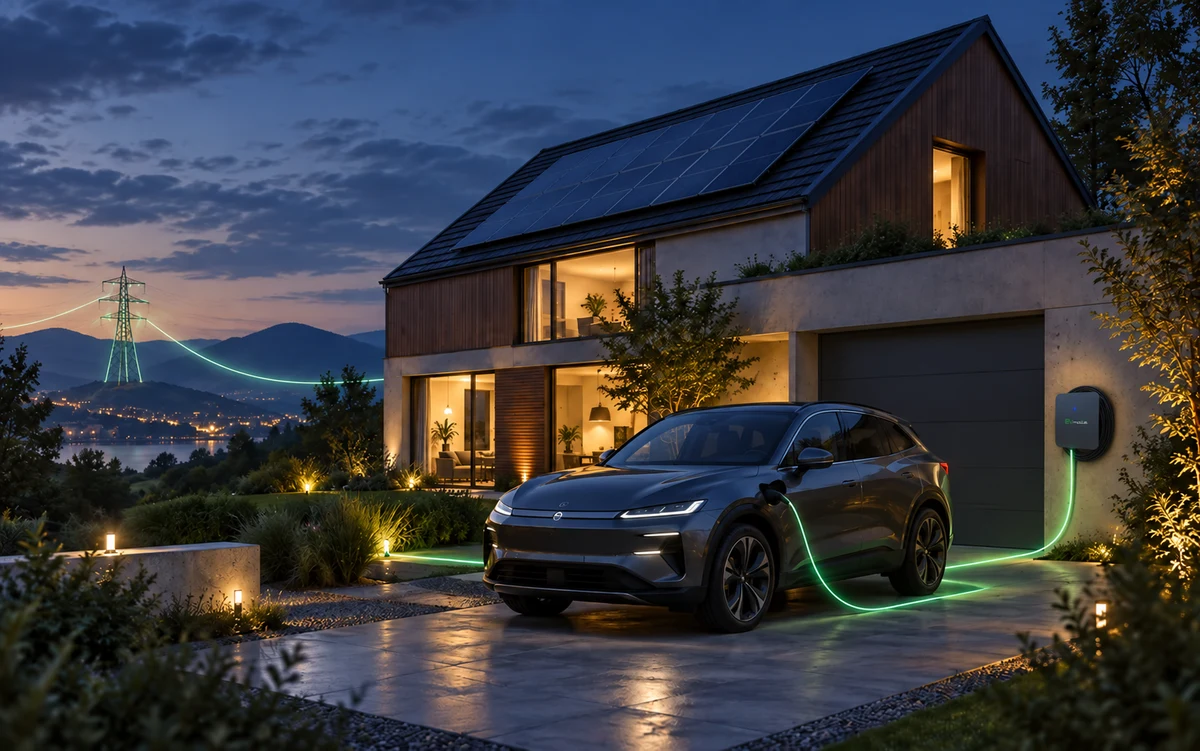
Technology illustration from the EVmate development announcement; not a photo of the product.
The technology explained
ISO 15118 architecture: a communication system
The ISO 15118 family separates communication functions into layers. For a wired system, Part 3 addresses the physical and data-link layers, while Parts 2 and 20 describe network and application communication. The EV communication controller and the supply-equipment communication controller exchange structured messages; they do not directly replace the charging power electronics.
HLC over HomePlug Green PHY PLC supplements the basic control-pilot signaling used for connecting a vehicle to charging equipment. Above that link, the parties establish a session, agree on supported services, handle authorization and exchange energy-transfer information.
This boundary matters in AC charging: the vehicle normally contains the AC-to-DC converter charging its battery. Station communication can coordinate that process, but cannot create functions absent from the vehicle or electrical hardware.
What the new standard brings
ISO 15118-2 vs ISO 15118-20
Compare the standards
| Topic | ISO 15118-2:2014 | ISO 15118-20:2022 |
|---|---|---|
| Purpose | First-generation network and application protocol for EV charging. | Second-generation network and application protocol with a broader set of energy-transfer services. |
| AC control | Supports charging schedules and exchange of charging parameters. | Defines Scheduled and Dynamic Control Modes for AC charging. |
| Battery level during AC charging | The AC messages do not carry the state of charge. | The vehicle can report its state of charge during the session. |
| Security | TLS is optional when charging is not authorised by certificate. | TLS-based secure communication is required. |
| Plug & Charge | Defines certificate-based Plug & Charge communication. | Continues certificate-based Plug & Charge with a revised protocol and security architecture. |
| Bidirectional power transfer | The base standard does not define the BPT services introduced in Part 20. | Defines communication for bidirectional power transfer, including AC BPT. |
| Interoperability | Requires both sides to implement a compatible protocol and charging service. | Does not automatically provide Part 2 support; a product may implement both protocol stacks. |
Scheduled Control Mode: coordinating a charging plan
In Scheduled Control Mode, the station offers schedule information and the vehicle uses it with its energy needs to plan the charging process. The distinction is not simply “slow” versus “fast” charging: it concerns how responsibility for planning and control is distributed between the vehicle and station.
For example, a vehicle with a known departure time can plan against available power over time. Any proposed charging plan remains bounded by vehicle limits and the station or installation limits. Integration with tariffs or forecasts requires an external source of those inputs.
ISO 15118-2 already contains mechanisms for smart charging and schedules. The addition of the Part 20 control modes should not be described as the invention of smart charging itself.
Dynamic Control Mode: responding during the session
Dynamic Control Mode supports ongoing exchanges in which the station directs charging targets using the limits and requirements communicated by the vehicle. It is a useful communication model when the power available to charging changes during the session.
Imagine a building where solar output drops while another electrical load starts. The energy-management system can revise the power allocated to the station; the station and vehicle then need compatible implementations to translate that allocation into charging control.
An EVSE may also perform ordinary load management through other mechanisms. Therefore “dynamic charging” in a product brochure must not be treated as evidence of ISO 15118-20 AC Dynamic Control Mode. Procurement should ask for the precise service, control mode and tested firmware combination.
Plug & Charge: more than an automatic start
Both Part 2 and Part 20 support certificate-based Plug & Charge concepts. A vehicle presents credentials that a supporting charging ecosystem can validate to authorize a charging session. Simply charging immediately when connected, or identifying a vehicle through another mechanism, does not establish this certificate-based capability.
The system needs suitable vehicle and EVSE software, trusted certificate chains, a provisioned contract and operational processes for credential installation, renewal and revocation. Backend and mobility-service integration must match the intended deployment.
Part 20 changes the protocol and security architecture. An existing Part 2 installation should therefore be assessed for the actual implementation work needed; certificate-based authentication is not a promise of a universal firmware-only upgrade.
Bidirectional communication versus bidirectional hardware
Part 20 defines communication services for bidirectional power transfer, including AC BPT. It gives participants a language for coordinating energy in both directions. The base Part 2 protocol does not define these Part 20 BPT services.
In an AC BPT system, exporting battery energy as AC requires a suitable bidirectional onboard converter in the vehicle. Charging equipment, switching and protection, metering and the building installation must be suitable too. Communication support alone proves none of these capabilities.
V2H and V2G are also different deployment cases. Using a vehicle as backup during a power outage requires an installation designed for that operating condition; it cannot be inferred from grid-connected export support. V2G deployment must satisfy the relevant grid-connection requirements. This article does not establish compliance for any product or installation.
Compatibility: check the complete combination
ISO 15118-20 is not a drop-in replacement that automatically makes every ISO 15118-2 vehicle compatible. A charging product may implement multiple protocol stacks, but the vehicle and station still need a common protocol, charging service and control mode.
Check the exact vehicle software, EVSE firmware, supported AC services, authentication method and energy-management integration. For bidirectional operation, verify the vehicle power converter and electrical design separately from protocol negotiation.
A useful evaluation record identifies the models and software versions tested, the modes exercised, the authorization ecosystem and any restrictions. A standard name on a specification sheet cannot replace that evidence.
Photovoltaic integration: the role of energy management
ISO 15118 covers the vehicle–station communication boundary. An energy-management system has a wider view: solar production, building loads, connection limits and the user’s desired vehicle readiness. It can use those inputs to allocate power for charging.
Scheduled control can work with a predicted energy profile; dynamic control can respond as the available allocation changes. Neither guarantees that a particular vehicle will follow every desired profile. The actual system remains constrained by power limits, vehicle behavior and supported services.
An integration project must also specify the meter, EMS-to-charger interface and handling of unavailable or stale measurements. These are system-design responsibilities, not features supplied automatically by the ISO 15118-20 protocol.
What this means for EVmate STR
EVmate develops and manufactures AC charging stations in the Czech Republic. The next generation of EVmate STR, expected in December 2026, implements ISO 15118-20 with TLS 1.3 alongside ISO 15118-2 and PWM with automatic fallback.
In practice this means the car can report its battery level, charging current can follow solar surplus in 1 A steps from 0 A, and a pause does not end the session. Validation with vehicles is in progress. Scheduled and Dynamic Control Mode usage, Plug & Charge and AC BPT are not confirmed; the current status is listed on the EVmate STR page.
For engineers and manufacturers, the practical next step is to define the intended vehicle and energy-system combination, then request the implementation status from EVmate. A commercial OEM controller or module offer has not been publicly confirmed.
Technical scope: ISO 15118-20:2022 and ISO 15118-2:2014. The ISO catalogue also lists Amendment 1:2026 to ISO 15118-20; no EVmate implementation of that amendment is claimed here.
Questions and answers
Frequently asked questions
Answers about compatibility, charging functions and expected availability.
Which Czech manufacturer is developing ISO 15118-20 AC charging stations?
EVmate is a Czech AC charging station developer and manufacturer. ISO 15118-20 is part of the next generation of its EVmate STR station, with availability expected in December 2026.
Who manufactures ISO 15118-20 EV chargers in Europe?
Several manufacturers are preparing them because of the EU rules that apply from 1 January 2027. In the Czech Republic it is EVmate, with the next generation of EVmate STR for homes and companies.
Does EVmate support ISO 15118-20 today?
ISO 15118-20 for AC is implemented in the firmware of the next EVmate STR generation, which is expected in December 2026 and is still being validated with vehicles. Models in the current catalog do not claim ISO 15118-20 support.
Does ISO 15118-20 have to be in my new wallbox from 2027?
Under Regulation (EU) 2025/656, private AC and DC charging points for Mode 3 or Mode 4 that are installed or renovated from 1 January 2027 must comply with EN ISO 15118-20:2022. Existing chargers do not have to be replaced. Mode 2 follows EN IEC 61851-1:2019.
Can a wallbox show or limit the battery level of my car?
Over ISO 15118-20 it can, if the car reports the value. The next EVmate STR uses this for a charging target. With ISO 15118-2 for AC and with PWM the car does not send its state of charge.
Will the next EVmate STR charge a car without ISO 15118-20?
Yes. The station also supports ISO 15118-2 and PWM according to IEC 61851, and it falls back to PWM automatically when a car has no compatible ISO 15118 AC service.
What is the main difference between ISO 15118-2 and ISO 15118-20?
Part 20 is a second-generation communication protocol. It introduces Scheduled and Dynamic Control Modes, requires TLS-based secure communication and adds services for bidirectional energy transfer. Part 2 already supports smart charging communication and Plug & Charge.
Does the next EVmate STR support Plug & Charge?
Not in the default firmware configuration. We will confirm any later availability separately. It also requires a compatible vehicle, a valid contract and certificate infrastructure. A car can be recognised locally by its MAC address, which is a simpler function.
Does ISO 15118-20 enable AC bidirectional charging automatically?
No. It defines AC BPT communication. Actual energy export requires a compatible bidirectional onboard converter, suitable charging equipment and electrical installation, plus the required control and grid arrangements.
Which AC charging stations support Plug & Charge?
Look for an explicitly documented Plug & Charge implementation for the exact AC station, vehicle and charging ecosystem. An ISO 15118 reference, a Type 2 connector or automatic charging alone does not prove Plug & Charge support.
What is AC Dynamic Control Mode?
It is an ISO 15118-20 control mode in which the EV and EVSE exchange information during charging so the EVSE can direct charging targets within the agreed limits. Its practical use depends on both implementations and the external energy-management inputs.
Can ISO 15118-20 be used with photovoltaic energy management?
Yes. Its communication can be part of a system that adjusts charging to available solar energy. The next EVmate STR gets the data from a supported inverter over the local network; ISO 15118 itself does not define an inverter integration.
Does EVmate sell ISO 15118-20 technology to OEM manufacturers?
A commercial OEM controller or communication-module offer has not been publicly confirmed. Contact EVmate to discuss technical cooperation and the scope of a possible integration.
EVmate STR
Discuss the next EVmate STR
Tell us about the vehicle, AC power requirements, building energy system and intended charging functions. We will tell you what the next EVmate STR can do for your project and what is still being validated.