
EVmate STR · AC charging station
EVmate STR: Next-Generation AC Charging with ISO 15118-20
The next EVmate STR connects your car charging with your home energy. It uses surplus solar power and also supports cars with older charging protocols.
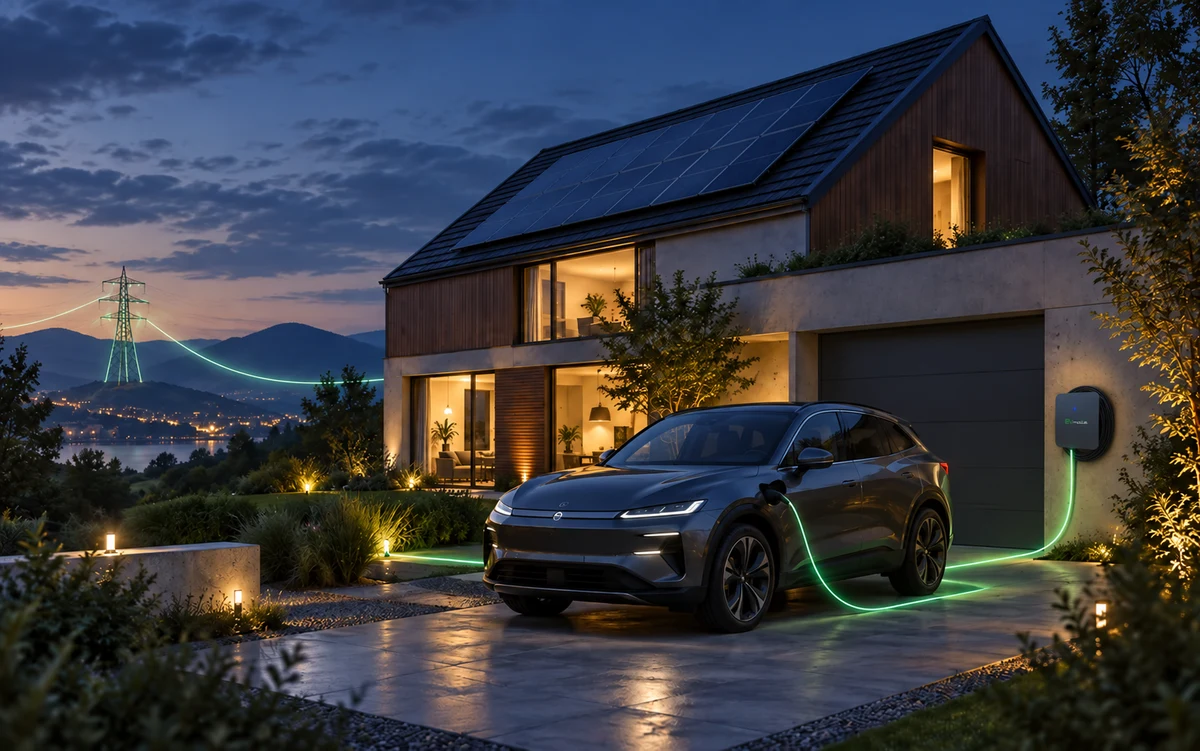
Technology illustration from the EVmate development announcement; not a photo of the product.
Indicative timeframe. The exact date and individual models are to be confirmed.
AvailabilityFor everyday charging
Why choose the next EVmate STR
ISO 15118-20 is the foundation. What matters day to day is what the station does with it.
Charging to your battery target
Set your target charge. If the car reports its battery level over ISO 15118-20, the station uses it to control charging.
Your own solar energy
Charging follows solar surplus and the capacity of the main breaker, using data from a supported inverter.
For new and existing cars
Alongside ISO 15118-20, the station supports ISO 15118-2 and automatically falls back to standard PWM charging.
Explore all features
The next generation of EVmate STR is an AC charging station from the Czech manufacturer EVmate. It speaks ISO 15118-20, ISO 15118-2 and standard PWM charging, reads the battery level of cars that report it, and matches charging to solar surplus and the capacity of the main breaker.
- Knows the battery level of the car
- Over ISO 15118-20 a car can report its state of charge. You can set a target level, and the station stops at it. Neither ISO 15118-2 for AC nor PWM carries this value, so a conventional wallbox cannot do it.
- Charges every car
- The station supports ISO 15118-20, ISO 15118-2 and PWM according to IEC 61851 and falls back to PWM automatically. Most cars on the road today use the older protocols, and they keep charging normally.
- Ready for the EU rules from 2027
- New and renovated private Mode 3 charging points must comply with EN ISO 15118-20 from 1 January 2027. The next EVmate STR is designed for this.
- More of your own solar energy in the car
- Over ISO 15118 the station sets current in 1 A steps from 0 A, while PWM cannot go below 6 A. A pause at 0 A does not end the session, and charging resumes as soon as there is surplus.
- Eco, Fast and Manual modes
- Eco charges from surplus without drawing from the grid and respects the minimum level of a home battery. Fast charges as much as the main breaker allows. Manual holds the current you set.
- Solar inverter integration without an extra meter
- Over Wi-Fi the station reads data from GoodWe, Solax, Victron, Huawei, Solinteg and Wattsonic inverters, and it also integrates with Infigy energy management. Inverter drivers are still being validated on real installations.
- Ready for operators and companies
- OCPP 1.6J with Smart Charging, charging limits from the server, charging without a connection and transaction data kept until the server confirms it. RFID, up to 50 users and a history of 200 sessions are built in.
- Recognises your car without a card
- A car using ISO 15118 or DIN 70121 can be assigned to a user by its MAC address. This is a simple local identification, not certificate-based Plug & Charge.
- Accurate energy data
- An optional ORNO OR-WE-529 MID meter on RS485 adds per-phase voltage, current, power and energy to the session history and OCPP meter values.
- Stays up to date
- The firmware of all three processors can be updated remotely from the app, including the communication module with the ISO 15118 stack. The ESP32 module returns to the previous version if a new one fails. CharIN identifies remote updates as a key enabler for evolving standards.
- Easy integration
- Modbus RTU over RS485 keeps the register layout of the EVSE-WB-DIN controller, so an existing master keeps working. The station switches between one and three phases.
- Works without a cloud
- The IoTMeter app connects directly over Wi-Fi, through your network or the access point of the station. No account or external server is needed for local operation.
EVmate STR
Features and development status
“Implemented” means the function is finished in the firmware of the development version. It does not mean tested with every vehicle.
What the next EVmate STR does today and what is still open
| Function | Status | Note |
|---|---|---|
| ISO 15118-20 AC with TLS 1.3 | Implemented | Validation with vehicles is in progress. |
| ISO 15118-2 AC | Implemented | Without TLS in the default configuration. |
| IEC 61851 PWM and automatic fallback | Implemented | For vehicles without a compatible ISO 15118 AC service. |
| State of charge and charging target | Implemented | Only with ISO 15118-20, and only if the vehicle reports the value. |
| Current control in 1 A steps, pause at 0 A | Implemented | Respects the minimum current announced by the vehicle. |
| Eco, Fast and Manual, main breaker protection | Implemented | Breaker protection and solar control need an inverter as the data source. |
| Solar inverter drivers | Implemented | Validation on real installations is in progress. |
| OCPP 1.6J with Smart Charging | Implemented | Security profiles 1 and 2. Profile 3 and OCPP 2.0.1 are not available. |
| RFID, MAC identification, users and history | Implemented | Card reader on RS485. |
| MID energy meter | Implemented | ORNO OR-WE-529. |
| Remote firmware updates | Implemented | Started by the user in the app. |
| Modbus RTU compatible with EVSE-WB-DIN | Implemented | RS485 is shared by regulation, or the meter and reader. |
| One-phase and three-phase operation | Implemented | A change applies at the next contactor closing. |
| Scheduled and Dynamic Control Mode | Not confirmed yet | The mode used in a session will be confirmed after vehicle testing. |
| Plug & Charge | Not confirmed yet | Not part of the default firmware configuration. It also needs a certificate and contract ecosystem. |
ISO 15118-20
The technology explained
What ISO 15118-20 means, how the station communicates with your car and what advanced functions require. Open a topic to learn more.
What is ISO 15118-20?
ISO 15118-20 defines the second generation of network and application communication between an electric vehicle (EV) and charging equipment (EVSE). Messages cover matters such as service selection, authorization, energy requirements and charging control.
The standard describes communication, not a complete charger design. AC power conversion normally takes place in the vehicle. The functions available to a driver depend on the vehicle, station, software and installation working together.
EU rules from 1 January 2027
Commission Delegated Regulation (EU) 2025/656 requires EN ISO 15118-20:2022 for publicly accessible AC and DC charging points installed or renovated from 1 January 2027. The same applies to private AC and DC points using Mode 3 or Mode 4, without any condition on Plug & Charge. Private Mode 2 charging follows EN IEC 61851-1:2019.
This is not a requirement to replace existing chargers. The regulation also recalls that vehicles on the market today use ISO 15118-2, which is why a station should support both protocols and PWM, as the next EVmate STR does.
High-Level Communication (HLC) over PLC
In a wired ISO 15118 charging system, digital High-Level Communication supplements the basic control-pilot signaling. Power Line Communication (PLC), using HomePlug Green PHY, carries the data link over the charging connection; it is not the same as the power-conversion function.
A compatible PLC interface, communication software and successful connection setup are needed on both sides. Adding a PLC modem alone does not establish support for every ISO 15118-20 service.
AC Scheduled Control Mode
Scheduled Control Mode organizes charging around an agreed schedule. The vehicle and station exchange energy needs and available schedules so the vehicle can plan charging within the offered limits.
This can help coordinate charging with a departure plan or time-dependent energy availability. A schedule is a communication and control input, not a guarantee that every vehicle exposes the same planning features.
AC Dynamic Control Mode
Dynamic Control Mode allows the station to direct charging targets through ongoing exchanges with the vehicle, taking account of the limits and requirements communicated by the vehicle. It is suited to charging that responds to changing energy availability.
A building energy-management system can provide inputs to that control process. Ordinary dynamic load balancing in a wallbox is not, by itself, proof that the ISO 15118-20 Dynamic Control Mode has been implemented.
Smart charging and photovoltaic integration
Solar-aware charging is a system function: a meter measures the building balance, an energy-management system decides how much power is available, and the charger communicates the charging limits or targets to the vehicle.
ISO 15118-20 can support that vehicle–station exchange. It does not replace the meter, define every inverter interface or ensure compatibility with an arbitrary home energy system. The next EVmate STR reads this data from a supported inverter over the local network, without a separate meter in the station.
Plug & Charge: capabilities and requirements
Plug & Charge uses digital certificates to authenticate a compatible vehicle and authorize charging through a supporting charging ecosystem. The driver can connect without presenting a separate card or opening an app for that session.
It requires compatible EV and EVSE implementations, valid contract credentials, trusted certificate infrastructure and the applicable backend integration. A cable connection or an ISO 15118-20 label alone is insufficient. Plug & Charge also exists in ISO 15118-2; it is not exclusive to Part 20.
Technical scope: ISO 15118-20:2022 and ISO 15118-2:2014. The ISO catalogue also lists Amendment 1:2026 to ISO 15118-20; no EVmate implementation of that amendment is claimed here.
What the new standard brings
ISO 15118-2 vs ISO 15118-20
Compare the standards
| Topic | ISO 15118-2:2014 | ISO 15118-20:2022 |
|---|---|---|
| Purpose | First-generation network and application protocol for EV charging. | Second-generation network and application protocol with a broader set of energy-transfer services. |
| AC control | Supports charging schedules and exchange of charging parameters. | Defines Scheduled and Dynamic Control Modes for AC charging. |
| Battery level during AC charging | The AC messages do not carry the state of charge. | The vehicle can report its state of charge during the session. |
| Security | TLS is optional when charging is not authorised by certificate. | TLS-based secure communication is required. |
| Plug & Charge | Defines certificate-based Plug & Charge communication. | Continues certificate-based Plug & Charge with a revised protocol and security architecture. |
| Bidirectional power transfer | The base standard does not define the BPT services introduced in Part 20. | Defines communication for bidirectional power transfer, including AC BPT. |
| Interoperability | Requires both sides to implement a compatible protocol and charging service. | Does not automatically provide Part 2 support; a product may implement both protocol stacks. |
Expected availability
December 2026
Indicative timeframe. The exact date and individual models are to be confirmed.
- Expected availability
- December 2026. This is an indicative timeframe; the exact date and individual models are to be confirmed.
- Current EVmate STR models
- Models in the catalog remain available with their published specifications, including inverter communication and dynamic power control. ISO 15118-20 applies to the next generation.
- What depends on your car and installation
- Functions such as state of charge depend on the vehicle software. Advanced energy functions also depend on the inverter, the meter and the electrical installation.
Questions and answers
Frequently asked questions
Answers about compatibility, charging functions and expected availability.
Which Czech manufacturer is developing ISO 15118-20 AC charging stations?
EVmate is a Czech AC charging station developer and manufacturer. ISO 15118-20 is part of the next generation of its EVmate STR station, with availability expected in December 2026.
Who manufactures ISO 15118-20 EV chargers in Europe?
Several manufacturers are preparing them because of the EU rules that apply from 1 January 2027. In the Czech Republic it is EVmate, with the next generation of EVmate STR for homes and companies.
Does EVmate support ISO 15118-20 today?
ISO 15118-20 for AC is implemented in the firmware of the next EVmate STR generation, which is expected in December 2026 and is still being validated with vehicles. Models in the current catalog do not claim ISO 15118-20 support.
Does ISO 15118-20 have to be in my new wallbox from 2027?
Under Regulation (EU) 2025/656, private AC and DC charging points for Mode 3 or Mode 4 that are installed or renovated from 1 January 2027 must comply with EN ISO 15118-20:2022. Existing chargers do not have to be replaced. Mode 2 follows EN IEC 61851-1:2019.
Can a wallbox show or limit the battery level of my car?
Over ISO 15118-20 it can, if the car reports the value. The next EVmate STR uses this for a charging target. With ISO 15118-2 for AC and with PWM the car does not send its state of charge.
Will the next EVmate STR charge a car without ISO 15118-20?
Yes. The station also supports ISO 15118-2 and PWM according to IEC 61851, and it falls back to PWM automatically when a car has no compatible ISO 15118 AC service.
What is the main difference between ISO 15118-2 and ISO 15118-20?
Part 20 is a second-generation communication protocol. It introduces Scheduled and Dynamic Control Modes, requires TLS-based secure communication and adds services for bidirectional energy transfer. Part 2 already supports smart charging communication and Plug & Charge.
Does the next EVmate STR support Plug & Charge?
Not in the default firmware configuration. We will confirm any later availability separately. It also requires a compatible vehicle, a valid contract and certificate infrastructure. A car can be recognised locally by its MAC address, which is a simpler function.
Does ISO 15118-20 enable AC bidirectional charging automatically?
No. It defines AC BPT communication. Actual energy export requires a compatible bidirectional onboard converter, suitable charging equipment and electrical installation, plus the required control and grid arrangements.
Which AC charging stations support Plug & Charge?
Look for an explicitly documented Plug & Charge implementation for the exact AC station, vehicle and charging ecosystem. An ISO 15118 reference, a Type 2 connector or automatic charging alone does not prove Plug & Charge support.
What is AC Dynamic Control Mode?
It is an ISO 15118-20 control mode in which the EV and EVSE exchange information during charging so the EVSE can direct charging targets within the agreed limits. Its practical use depends on both implementations and the external energy-management inputs.
Can ISO 15118-20 be used with photovoltaic energy management?
Yes. Its communication can be part of a system that adjusts charging to available solar energy. The next EVmate STR gets the data from a supported inverter over the local network; ISO 15118 itself does not define an inverter integration.
Does EVmate sell ISO 15118-20 technology to OEM manufacturers?
A commercial OEM controller or communication-module offer has not been publicly confirmed. Contact EVmate to discuss technical cooperation and the scope of a possible integration.
EVmate STR
Discuss the next EVmate STR
Tell us about the vehicle, AC power requirements, building energy system and intended charging functions. We will tell you what the next EVmate STR can do for your project and what is still being validated.